
How to Tell If an IPTV Service Is Legal and Legit in the USA (2026)
Choosing an IPTV provider in 2026 can feel surprisingly difficult. Search for an IPTV subscription and you will find polished websites, massive channel claims, low annual prices, free trials, apps for nearly every streaming device, and providers describing themselves as “premium,” “secure,” or “legal.” The problem is that none of those words, by themselves, prove that an IPTV service is legitimate.
IPTV is simply a technology for delivering television and video over an internet connection. The technology itself has many lawful uses. The legal question normally concerns the content being distributed: does the service have authorization to provide the television channels, sports broadcasts, movies, or other programming it offers? That distinction matters. A professional-looking website does not automatically prove licensing, and an unfamiliar IPTV provider is not automatically illegal simply because you have never heard of it. The smarter approach is to evaluate the evidence.
Quick answer: A legal IPTV service should have the necessary rights or authorization for the content it distributes. Consumers should look for clear business information, transparent terms, realistic claims, accessible customer support, secure payment options, clear subscription and refund rules, and credible information about content rights. No single badge, app, payment processor, DMCA page, or “100% legal” statement proves legality on its own.
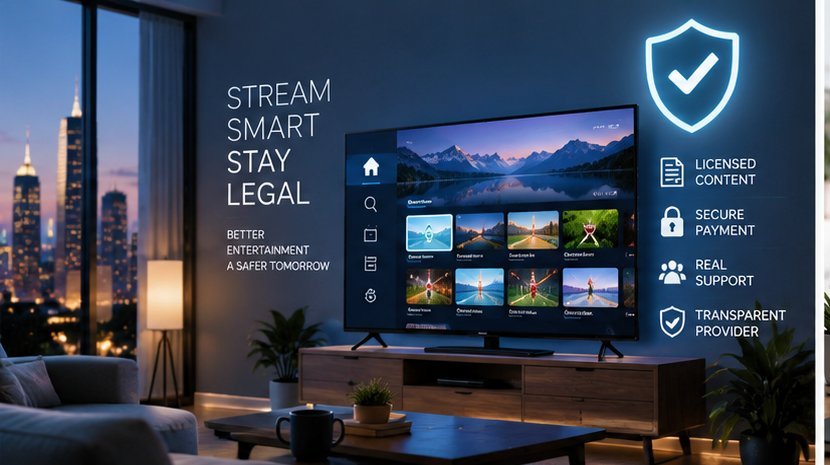
This guide explains how to identify a legal IPTV service in the United States, which warning signs deserve extra attention, how to evaluate payment and privacy risks, and what you should check before purchasing an IPTV subscription.
This guide is for general information and consumer education. It is not legal advice.
Table of Contents
What Is a Legal IPTV Service?
A legal IPTV service is a television or video service that uses internet protocol technology while distributing content under appropriate rights, permissions, licenses, or other lawful arrangements.
IPTV technology is not inherently suspicious. Telecommunications companies, broadcasters, streaming platforms, hotels, universities, businesses, and other organizations can all use IP-based systems to deliver video. The issue begins when copyrighted programming is reproduced, retransmitted, or sold without authorization.
This means two services can use very similar technology while having completely different legal positions. One may have contractual rights to distribute a particular group of channels. Another may simply capture or acquire copyrighted streams and resell access without permission. From a customer’s perspective, those technical systems may look almost identical inside an IPTV player.
That is why judging legality based only on picture quality, channel count, an M3U URL, Xtream credentials, or the app being used is unreliable. If you want the broader legal background first, our guide on whether IPTV is legal in the USA covers the copyright framework in detail. This article focuses on the practical side: evaluating a specific provider.
Legal IPTV vs. “Legit” IPTV
People often use legal and legit as if they mean the same thing, but it helps to separate them.
Legal mainly concerns whether the provider has the rights required to distribute the content.
Legitimate is broader. A legitimate business should also behave transparently toward customers. It should explain what is being sold, charge customers as promised, provide real ways to contact support, protect payment information, disclose important subscription conditions, and follow its stated refund or cancellation rules.
A provider can look professional without proving content rights. Likewise, a secure checkout protects the payment transaction, but it does not certify every television channel offered by the business. When evaluating a legal IPTV service, you therefore need to look at several signals together.
The 7-Point Legal IPTV Service Check
Instead of trusting one claim on a sales page, use seven areas of evidence:
- Provider identity and transparency
- Content and licensing information
- Pricing and offer realism
- Payment safety
- Terms, refunds, and cancellation information
- Apps, installation methods, and security
- Marketing claims and overall consistency
A strong provider should perform reasonably well across all seven. One weak signal does not automatically prove wrongdoing, but several red flags together should make you more cautious.
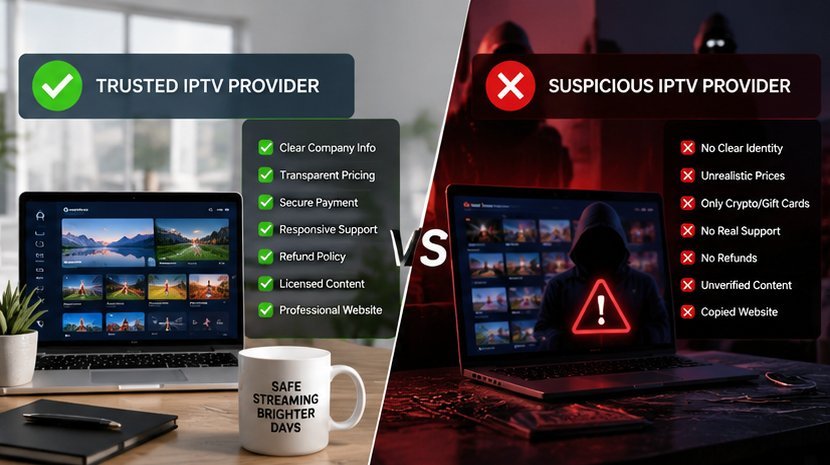
1. Check Who Is Actually Behind the IPTV Provider
Start with the website itself. A trustworthy IPTV provider should give customers enough information to understand who they are dealing with. Look for a functioning Contact page, clear terms, a Privacy Policy, refund or cancellation information, and a consistent business identity.
Pay attention to whether the company name changes between pages. For example, if the homepage uses one brand, the checkout uses an unrelated company, customer emails arrive under a third name, and the Terms of Service identify a fourth business, you should investigate before paying.
Brand names and legal company names can legitimately be different. Many companies operate under trade names. The important part is whether the relationship makes sense and is explained rather than deliberately hidden.
Check the Contact Information
A contact form is useful, but ideally it should not be the only evidence that support exists. Look for practical support information such as an email address, customer-service page, help center, or another established way to contact the business.
Try contacting the provider before purchasing a long subscription. Ask a normal question about device compatibility, billing, cancellation, or the package you are considering. You are not only testing response speed. You are checking whether the answer appears to come from someone who understands the service instead of a seller who responds with nothing except a payment link.
Search the Business Name Separately
Do not rely exclusively on testimonials displayed on the provider’s own website. Search the brand name together with terms such as:
- “reviews”
- “complaints”
- “refund”
- “scam”
- “support”
Look across multiple sources instead of trusting one review platform. The U.S. Federal Trade Commission recommends researching unfamiliar online sellers, reading reviews critically, checking policies, and keeping records of purchases.
A legitimate online presence is not proof of content licensing, but transparent business behavior is still an important part of assessing risk.
2. Look for Evidence About Content Rights, Not Just the Word “Legal”
This is the most important part of the legal IPTV question. A provider saying “we are legal” is not the same thing as demonstrating why it is authorized to distribute specific content.
When possible, look for information explaining the content relationship. That could include licensing information, partnerships, distribution arrangements, channel availability by territory, official app-store relationships, or other credible evidence appropriate to the service.
You should become more cautious when a provider simultaneously claims to offer practically every premium television network, every major sports package, newly released movies, international premium channels, and pay-per-view events for a price dramatically below the normal cost of obtaining those services separately, while providing no explanation of content rights.
Price alone does not establish illegality. A huge channel library alone does not establish illegality. But the combination of extraordinary content claims, extremely low pricing, and zero licensing transparency deserves additional verification.
Copyright Enforcement Is Real
Unauthorized commercial streaming is not merely a theoretical concern in the United States. The U.S. Department of Justice has prosecuted operators of unauthorized subscription streaming businesses. In 2025, five defendants connected to Jetflicks were sentenced after convictions involving a subscription service that distributed copyrighted television programming without permission.
In another case, a Florida man received a federal prison sentence after pleading guilty to providing illegal access to digital streaming services. The DOJ described it as believed to be the first conviction in the nation under the Protecting Lawful Streaming Act.
These cases are useful because they show the core issue clearly: unauthorized commercial distribution of copyrighted programming can create serious legal exposure for operators. They also demonstrate why consumers should not assume that every paid streaming subscription is authorized simply because money changes hands.
3. Ask Whether the Price and Package Make Sense
Everyone wants value, and a low IPTV subscription price is not automatically suspicious. But price should make sense when compared with what the provider claims to deliver.
Imagine a seller advertising thousands of premium channels, every major U.S. sports network, international sports packages, premium movie services, pay-per-view events, and an enormous on-demand library for only a few dollars per year. At that point, price becomes part of your due diligence. Ask yourself a simple question:
How could this business economically provide everything it claims to sell?
This does not mean you need to calculate the provider’s operating costs. It means unusually large promises should come with unusually strong evidence. If you want a realistic benchmark, our breakdown of IPTV subscription pricing explains what typical monthly and yearly plans cost and why.
Be Careful With “Lifetime IPTV” Offers
Lifetime subscriptions deserve particular caution. Streaming infrastructure costs money continuously. Bandwidth, technical maintenance, customer support, hosting, apps, and content rights do not become free after someone makes a one-time payment.
A provider can define “lifetime” in ways customers do not expect, such as the lifetime of an account, application, reseller, or server. If you see a lifetime IPTV subscription, read the exact terms. Ask what “lifetime” means and what happens if the platform changes.
For unfamiliar providers, a short subscription can reduce your financial exposure while you evaluate the service. That does not solve licensing questions, but it prevents you from committing a large amount of money before you know how the business operates.
4. Examine How the IPTV Service Accepts Payment
Payment method is an underrated trust signal. Again, it is not a licensing certificate. A service can accept cards and still have other problems. But the way a seller asks you to pay can tell you something about your consumer risk.
The FTC recommends paying by credit card when possible because consumers generally have stronger dispute protections when something goes wrong. The agency also warns consumers to be cautious when unfamiliar sellers insist on payment methods that are difficult to reverse, including certain wire transfers, gift cards, payment apps, or cryptocurrency.
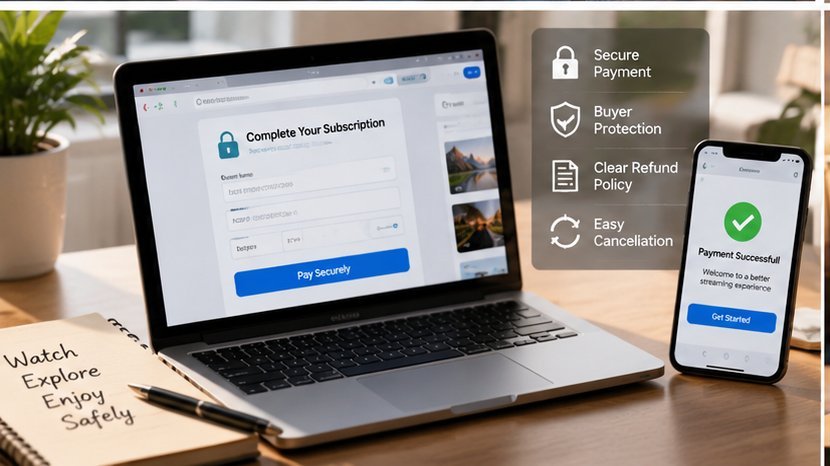
Secure Checkout Is Good, But It Does Not Prove a Legal IPTV Service
Suppose an IPTV provider uses HTTPS and a recognized payment processor. That is positive for payment security. It still does not mean that the payment company has independently verified the distribution rights for every channel in the package.
This distinction is important because consumers sometimes assume: “PayPal accepted the merchant, so the channels must be licensed,” or “The checkout accepts Visa, so the service must be legal.” Neither conclusion necessarily follows. Evaluate payment security and content legality separately.
Watch for Strange Payment Instructions
Be cautious if the checkout advertises normal card payments but support suddenly tells you to send money to an unrelated individual, purchase gift cards, buy cryptocurrency through another website, or misrepresent what you are purchasing.
You should also question unexplained changes in merchant names. There may be legitimate reasons for a billing descriptor to differ from a brand name, but the provider should be able to explain the relationship clearly.
Before paying, save the order page, price, subscription duration, refund conditions, and confirmation message.
5. Read the Refund, Renewal, and Cancellation Terms Before Buying
A professional IPTV service should tell you what happens after payment. You should be able to answer basic questions such as:
- How long does the subscription last?
- Does it automatically renew?
- How many simultaneous devices or connections are included?
- When does the subscription begin?
- Is there a trial?
- When can a refund be requested?
- How do cancellations work?
- Are app-license costs separate from the IPTV subscription?
- What happens if the service cannot be activated?
These are normal buying questions. If a provider makes them difficult to answer before payment, consider that a warning sign.
“No Refunds Under Any Circumstances” Deserves Attention
Digital services sometimes have more restrictive refund policies than physical products, and refund rules can vary. Still, customers should know the policy before they buy. Look for specific conditions rather than vague statements.
If a seller advertises a money-back guarantee prominently but the policy page contains exceptions that make the guarantee practically impossible to use, that inconsistency matters. The FTC advises online shoppers to review refund terms and maintain purchase records.
Check Auto-Renewal Carefully
Subscription businesses sometimes renew automatically. That is not inherently suspicious. The problem is when renewal is hidden or unclear.
Before entering payment details, find out whether you are purchasing a fixed-term IPTV subscription or agreeing to recurring billing. Keep the confirmation email.
6. Evaluate the IPTV App and Installation Instructions
An IPTV player is not the same thing as an IPTV provider. Applications such as media players can simply provide a way to load a playlist or credentials. The legality depends on how the software is used and where the content comes from.
This distinction is particularly important with Smart TVs, Android TV devices, Fire TV devices, Apple TV, smartphones, and dedicated streaming boxes.
App Availability Does Not Prove the Subscription Is Licensed
Finding an IPTV player in an official app store may give you more confidence in the application itself. It does not automatically verify the provider whose playlist you later add. The app developer and content provider may be completely separate businesses.
Likewise, an app disappearing from an app store is not, by itself, proof that every service used with the app is illegal. Use the app as one part of the security evaluation, not as your legal test.
Be Careful With Unknown APK Files
Android and Fire TV users are sometimes asked to install apps outside an official app store. Sideloading itself has legitimate uses, but it deserves more caution because you are installing software from another source.
Before installing an unknown APK, ask why it is required. Check the publisher. Review requested permissions. Be particularly skeptical if a streaming application requests access that appears unrelated to streaming, such as contacts, SMS messages, accessibility control, or other sensitive device functions without a clear reason.
A trustworthy provider should not pressure you to disable major security protections without explaining what you are doing. Our IPTV safety guide goes deeper into app security, malware risks, and how to protect your devices and personal data.
7. Read the Marketing Claims Like a Skeptic
A good IPTV provider should be able to market its service without making impossible promises. Watch for claims such as:
- “100% guaranteed zero buffering forever”
- “Every television channel in the world”
- “Every premium service included”
- “Completely anonymous and untraceable”
- “Government approved”
- “Official partner” without identifying the partner
- “100% legal” without explaining the basis
- “No VPN can ever be required”
- “Works perfectly on every internet provider”
Streaming quality depends on many factors, including the content source, server capacity, internet route, home network, device, application, Wi-Fi conditions, and peak-time congestion. No responsible provider can control every variable on the customer’s side. More measured language is usually a better trust signal than absolute guarantees.
Legal IPTV Service vs. Unverified IPTV Service
| Check | More Trustworthy Signal | Reason for Caution |
|---|---|---|
| Business identity | Consistent brand and company information | Multiple unexplained names |
| Contact | Accessible support and clear contact methods | Payment-only communication |
| Content rights | Credible licensing/authorization information where relevant | Massive premium library with no rights information |
| Pricing | Clear and understandable subscription pricing | Implausibly cheap “everything included” claims |
| Payment | Secure checkout and reasonable buyer protections | Only irreversible payment methods |
| Refunds | Published terms before purchase | Guarantee advertised but conditions hidden |
| Renewal | Fixed-term or renewal rules clearly explained | Surprise recurring charges |
| App security | Known apps or transparent installation instructions | Unknown software requesting unnecessary permissions |
| Marketing | Specific, verifiable claims | Impossible guarantees |
| Website | Working policies, contact pages, HTTPS | Broken pages and copied boilerplate |
Use this table as a quick way to separate a legal IPTV service from an unverified one, but do not treat it as a mathematical score where six green boxes automatically make an IPTV provider legal. Licensing remains the central legal question. The purpose of the checklist is to identify situations that deserve more investigation.
Does Having a DMCA Policy Mean an IPTV Service Is Legal?
No. A DMCA or copyright policy can be a positive transparency measure, especially for an online business that may receive copyright notices. But the existence of a page titled “DMCA Policy” does not prove the company owns or licenses every piece of content it distributes, and it does not turn an unverified provider into a legal IPTV service.
Read the page. Does it explain how copyright owners can contact the company? Is there a real process for notices? Does the business identity match the rest of the website? Does the page look like generic text copied from another site?
A DMCA policy should be evaluated as one piece of a larger compliance picture. Consumers should avoid treating legal-sounding pages as certification badges.
Is IPTV Legal on a Firestick?
Using IPTV technology on an Amazon Fire TV Stick is not inherently illegal. A Firestick is simply a streaming device. You can use it with numerous lawful applications and video services.
The relevant legal issue is the service and content being accessed, not the fact that the device is a Firestick. This means installing an IPTV player on Fire TV does not by itself tell you whether the underlying television package is licensed. Think of the device as a screen and playback platform. The source still matters.
The same logic applies to Android TV boxes, Google TV, Apple TV, Samsung and LG Smart TVs, smartphones, tablets, computers, MAG devices, and other streaming hardware: the device never makes or breaks a legal IPTV service.
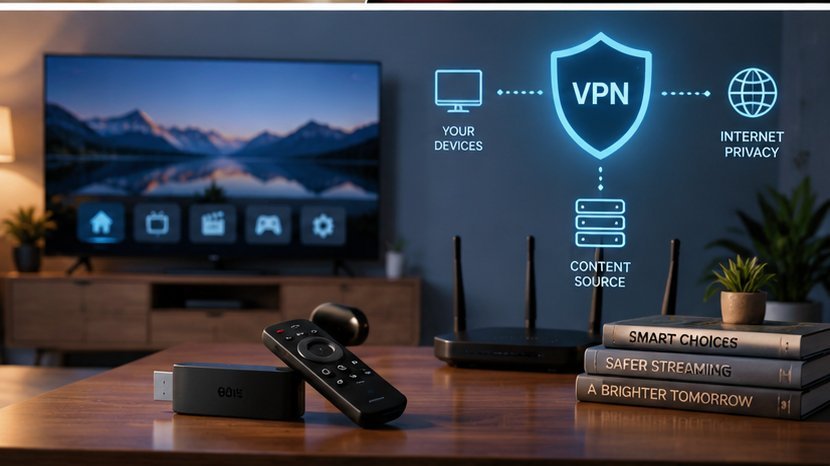
Does a VPN Make IPTV Legal?
No. A VPN changes the way your internet connection is routed and can provide privacy and networking benefits. It does not create content rights.
If a service is authorized, using a VPN does not make it more legally licensed. If a service lacks required rights, using a VPN does not magically give the provider permission to distribute the content or turn it into a legal IPTV service. This is one of the most common misconceptions in IPTV discussions. VPN questions and content-licensing questions should be treated separately.
A VPN can also affect location-dependent services because legitimate streaming platforms often license programming by territory. Always follow the terms of the service you are using and the rules that apply where you live. If you are weighing the privacy side of the question, our VPN for IPTV guide explains when a VPN is useful and when it is not.
Can IPTV Users Get in Trouble in the USA?
This question needs more nuance than many websites provide. U.S. enforcement actions publicly highlighted by the Department of Justice have often focused on people running, supplying, or profiting from unauthorized streaming businesses. For example, federal cases involving Jetflicks and other streaming operations focused on the people who operated or supplied unauthorized commercial services.
That should not be interpreted as a universal promise that subscribers can never face consequences. Copyright law is fact-specific, and different activities can raise different legal issues. A consumer who is uncertain about a particular service should avoid relying on statements from the seller itself such as “users can never get in trouble.” For legal advice about a specific situation, speak with a qualified U.S. attorney.
From a practical consumer perspective, the safest approach is straightforward: use streaming services and content sources that you have good reason to believe are authorized.
How to Verify an IPTV Provider Before You Subscribe
Do the verification before paying for a twelve-month plan. Start with the provider’s homepage and then deliberately move away from the sales copy:
- Read its Terms and Conditions.
- Read the Privacy Policy.
- Read its refund and cancellation rules.
- Open the Contact page.
- Look for information about the business operating the website.
- Search the provider independently.
- Check how payment works.
- Look at the installation instructions.
- Review the channel claims.
- Then contact support with one or two real questions.
If the provider cannot explain its own pricing, device limits, trial rules, or refund terms before payment, a longer subscription is difficult to justify.
If legality is a major concern, ask specifically how the provider is authorized to distribute the programming you want to watch. Avoid asking only “Is your IPTV legal?” Almost every seller knows the answer you want to hear. Ask a more useful question:
“What information can I review to verify your rights or authorization to provide the channels included in this package?”
The quality of the answer tells you far more.
12 IPTV Red Flags Worth Investigating
Even a legal IPTV service can have an occasional weak spot, so a single red flag may have an innocent explanation. Several together should make you cautious. Watch for:
- Anonymous sellers who refuse to provide basic business information.
- Checkout pages that suddenly redirect to unrelated merchants.
- Payment instructions that require only difficult-to-reverse methods.
- Copied Terms of Service containing another company’s name.
- Broken refund and contact pages.
- Extremely cheap lifetime subscriptions.
- Claims to include virtually every premium service on Earth.
- Support agents who refuse to answer licensing questions.
- Applications from unknown sources that demand unnecessary device permissions.
- Guarantees that buffering can never happen.
- Repeated unexplained domain changes.
- A provider that pressures you to pay immediately before a “special price” disappears.
Good purchasing decisions usually come from slowing down, not rushing.
Why “Thousands of Channels” Is Not Enough to Judge an IPTV Service
Channel count is one of the industry’s favorite marketing numbers. But it is a poor measure of legitimacy and often a poor measure of quality. A list of 30,000 channels could contain duplicates, offline channels, regional variations, test streams, or programming you will never watch.
For most buyers, a better question is whether the channels they actually need are available, reliable, organized, and legitimately distributed. The same principle applies to VOD counts. Do not choose an IPTV subscription because one website claims 100,000 movies while another claims 120,000. More is not automatically better. Look at transparency and actual usefulness.
What About Sports IPTV Services?
Sports are an especially important area for due diligence because broadcasting rights are valuable and frequently licensed by territory. A provider advertising NFL, NBA, NHL, MLB, soccer, combat sports, and premium pay-per-view events should be evaluated with the same licensing questions described throughout this guide, and a legal IPTV service should be able to explain where its sports rights come from.
The fact that a stream works technically does not tell you whether redistribution is authorized. Likewise, a provider saying “PPV included” does not establish its rights to sell those broadcasts. Consumers searching for an IPTV service primarily for live sports should pay particular attention to who owns the rights in their country and how the IPTV service says it receives permission to provide them.
Is a Free IPTV Trial a Sign of Legitimacy?
Not necessarily. A trial can be useful because it lets you evaluate streaming quality, compatibility, channel organization, EPG behavior, and customer support before buying a longer plan. But a working trial does not prove licensing or confirm that you are dealing with a legal IPTV service. Unauthorized services can offer trials too.
Use a trial to answer technical questions, not legal ones. Check how the trial converts into a paid subscription. Make sure you know whether your payment method will be charged automatically. Never provide unnecessary sensitive information simply to test a streaming service.
Why HTTPS Is Important, and Why It Is Not Enough
If a website asks for payment or personal information, HTTPS is essential. It encrypts the connection between your browser and the website. But a padlock icon only tells you something about connection security. It does not tell you that the business behind the website is honest.
The FTC specifically notes that scammers know how to encrypt sites too. Use HTTPS as a minimum requirement rather than a trust guarantee.
How to Compare IPTV Subscription Providers More Intelligently
Most IPTV comparisons focus on price, channels, and picture quality. Those things matter, but they should come after the fundamentals. When comparing providers, begin with transparency:
- Can you understand what the company sells?
- Can you identify subscription duration and connection limits?
- Are terms available before checkout?
- Is support reachable?
- Does the provider explain what happens if activation fails?
- Are payment methods clear?
- Are commercial claims consistent across the website?
Then compare the practical features: supported devices, EPG, VOD, channel categories, streaming quality, geographic availability, setup difficulty, customer support, subscription length, and price. This produces a much better decision than ranking IPTV services solely by channel count.
How This Fits With Choosing the Best IPTV Service
Searches for the best IPTV service, IPTV subscription, and IPTV provider often have commercial intent. People are ready to buy. That makes due diligence even more important.
Before you compare prices, use this legal IPTV service checklist to remove providers that do not meet your minimum trust requirements. Then compare the remaining options based on features and value.
On SmartVPro, readers can also compare IPTV subscription plans, review device compatibility and setup guides, and read our take on choosing an IPTV service that fits how you actually watch. Those commercial guides are designed to answer a different question from this article.
This page focuses specifically on how to evaluate whether an IPTV provider looks transparent, legitimate, and properly authorized before you purchase.
Questions You Should Ask an IPTV Provider
Before buying, consider asking:
- What exactly is included in the subscription?
- How many simultaneous connections are included?
- Is the plan fixed-term or recurring?
- What payment methods are accepted?
- What is the refund or cancellation policy?
- Which devices and applications are supported?
- Is an additional player license required?
- How is customer support provided?
- What information is available about content rights or authorization?
- Are channel packages different by country?
- Are there restrictions on travel or VPN use?
- What happens if the service cannot be activated on my device?
A legitimate provider should not consider basic customer questions unreasonable.
Final Verdict: How Can You Tell If an IPTV Service Is Legal?
There is no single logo, price, payment method, app, or website badge that can instantly prove whether an IPTV service is legal. The central issue is authorization to distribute the content: a legal IPTV service is defined by its rights, not its design. Everything else helps you judge the credibility of the business around that service.
Start by checking the provider’s identity and contact information. Read its policies. Look closely at its content claims. Evaluate payment safety. Understand the subscription terms. Review how applications are installed. Search independent sources. Ask specific questions about authorization instead of simply accepting “100% legal” marketing language.
Most importantly, do not let a huge channel count or a low annual price replace basic due diligence. A good IPTV subscription should not require you to ignore obvious questions before handing over your payment details.
Consumers who take ten minutes to investigate a provider before buying are much better positioned to distinguish a professional streaming business from an offer that creates unnecessary legal, financial, privacy, or security risks.
Frequently Asked Questions About Legal IPTV Services
Is IPTV legal in the United States?
IPTV technology itself can be used legally in the United States. The key issue is whether the service has the rights or authorization necessary to distribute the programming it offers. IPTV is a delivery method, not a legal classification.
How do I know if an IPTV provider is legitimate?
Check the provider’s business information, contact options, policies, payment methods, subscription terms, installation instructions, independent reputation, and information about content authorization. Do not rely on one signal alone.
Are all paid IPTV subscriptions legal?
No. Charging a subscription fee does not by itself prove that a provider is authorized to distribute copyrighted programming. U.S. authorities have prosecuted commercial subscription streaming operations that distributed copyrighted content without permission.
Does PayPal or credit-card acceptance prove an IPTV service is legal?
No. Recognized payment methods can improve transaction protection, but they do not automatically certify the licensing status of every channel or movie sold by the merchant.
Is IPTV legal on Amazon Firestick?
Using an IPTV application or IPTV technology on a Firestick is not inherently illegal. The legality depends on the content source and whether the service is authorized to distribute it.
Is an IPTV player illegal?
An IPTV player is generally software used to play streams or playlists. The app itself and the content provider are often separate. The relevant question is what content is being accessed and whether it is lawfully provided.
Does using a VPN make an IPTV service legal?
No. A VPN changes network routing and may improve privacy, but it does not create copyright or distribution rights.
Is a very cheap IPTV subscription illegal?
Not automatically. Price alone cannot prove legality. However, a remarkably low price combined with a huge premium-content library and no licensing transparency should encourage additional verification.
Does a DMCA page prove an IPTV provider is legitimate?
No. A copyright or DMCA policy can demonstrate awareness of copyright procedures, but its existence alone does not establish that all programming distributed by the provider is licensed.
Is a free IPTV trial safe?
A trial can help evaluate technical performance and device compatibility, but it does not prove the service is legally authorized. Review payment conditions, application security, privacy practices, and subscription terms before testing an unfamiliar provider.
What is the safest way to pay for an IPTV subscription?
For unfamiliar online businesses, payment methods with meaningful consumer protections are generally preferable. The FTC recommends credit cards when possible and warns consumers about sellers that insist on difficult-to-reverse payment methods.
Can IPTV users get in trouble in the USA?
Legal consequences depend on the facts and activity involved. Public U.S. enforcement cases have prominently targeted operators and suppliers of unauthorized commercial streaming services. That should not be interpreted as a guarantee about every subscriber or situation. If you need advice about a specific service or legal exposure, consult a qualified attorney.
What should I check before buying a 12-month IPTV subscription?
Check the provider’s identity, support, payment method, cancellation and refund policy, connection limits, device compatibility, application requirements, content authorization, and independent reputation. If you are uncertain, avoid a long commitment until you have resolved those questions.
Bottom Line
The best question is not simply: “Does this IPTV service work?”
It is: “Do I have enough reliable information to trust how this IPTV service operates and provides its content?”
That question protects you far better than a channel-count claim, a discount timer, or a “100% legal” badge ever will.