
Is IPTV Legal in USA?
If you have searched for a cheaper or more flexible way to watch television, you have probably encountered the term IPTV. It appears in discussions about smart TVs, Firestick devices, streaming apps, sports, international channels, and alternatives to traditional cable.
That popularity has also created one major question:
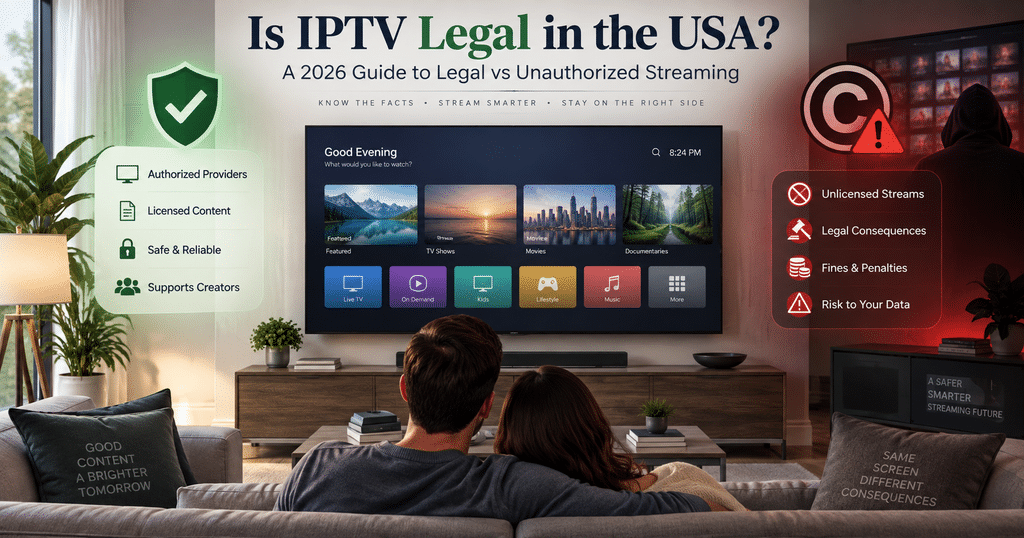
The short answer is yes: IPTV technology itself is legal in the United States. IPTV simply describes a method of delivering television and video through internet protocol rather than through a traditional cable line, satellite dish, or antenna.
The legal issue is not the technology.
The important question is whether the movies, television channels, sporting events, and other copyrighted programming being transmitted through an IPTV service are being distributed with the necessary authorization.
That distinction sounds simple, but the IPTV market can make it surprisingly difficult for an ordinary consumer to determine what is legitimate and what is not.
This guide explains what IPTV is, how IPTV works, what U.S. copyright law says, how IPTV subscriptions differ from IPTV player apps, whether IPTV on Firestick is legal, what risks illegal IPTV services create, and what consumers should check before paying for a service.
For readers looking for an additional U.S.-focused resource, SmartVPro also maintains a detailed guide about IPTV legality here:
Quick Answer: Is IPTV Legal in the USA?
Yes, IPTV is legal in the USA as a technology.
Internet Protocol Television is simply a system for delivering video over an internet connection.
Many well-known television and streaming platforms use internet-based video delivery.
However, an IPTV provider may operate illegally if it retransmits copyrighted channels, movies, television programs, live sporting events, or other protected content without authorization from the copyright owners or distributors.
Therefore, when someone asks “is IPTV legal?”, there are really two separate questions:
- Is IPTV technology legal?
- Is the specific IPTV service distributing its content legally?
The answer to the first question is generally yes.
The answer to the second question depends on the provider, the programming being offered, and whether the provider has the necessary rights.
Key Takeaways
Before going deeper into U.S. IPTV laws, here are the most important points:
- IPTV technology itself is legal in the United States.
- Copyright owners control important rights relating to reproduction, distribution, public performance, and authorization of copyrighted works.
- An IPTV service can become legally problematic when it distributes copyrighted programming without permission.
- IPTV player apps are generally just software and do not automatically include television rights.
- Installing an IPTV app on a Firestick does not itself make the activity illegal.
- A VPN does not turn unauthorized streaming into authorized streaming.
- Extremely cheap access to large collections of premium programming should encourage additional research rather than blind trust.
- Consumers should look at licensing transparency, business information, payment security, refund terms, privacy, support, and content claims.
- Legal risks are generally much greater for operators running commercial illicit streaming services than for ordinary viewers.
- Consumers can still face practical risks from questionable services, including service shutdowns, payment disputes, malware, credential theft, and loss of subscription money.
Table of Contents
What Is IPTV?
IPTV stands for Internet Protocol Television.
Traditional television systems typically deliver programming through one of several technologies:
- terrestrial broadcasts,
- coaxial cable networks,
- fiber television systems,
- or satellite signals.
IPTV uses internet protocol networks instead.
In simple language, video programming is transmitted as internet data and displayed through compatible hardware or software.
A viewer might access IPTV through:
- a smart television,
- Amazon Fire TV or Firestick,
- Android TV,
- Apple TV,
- smartphone,
- tablet,
- computer,
- dedicated set-top box,
- or IPTV player application.
IPTV is therefore much broader than the small subscription services people sometimes associate with the term.
Large telecommunications companies, broadcasters, and legitimate streaming platforms can all use technologies that fall within the broad concept of internet-delivered television.
That is why saying “IPTV is illegal” is inaccurate.
The technology itself is neutral.
A better analogy is a web browser.
A browser can display completely lawful content or content that infringes somebody else’s rights. The legality depends on what is being distributed and how it is being used, not simply on the existence of the browser.
The same principle applies to IPTV.
How Does IPTV Work?
Another popular question is how does IPTV work?
At a basic level, the process is straightforward.
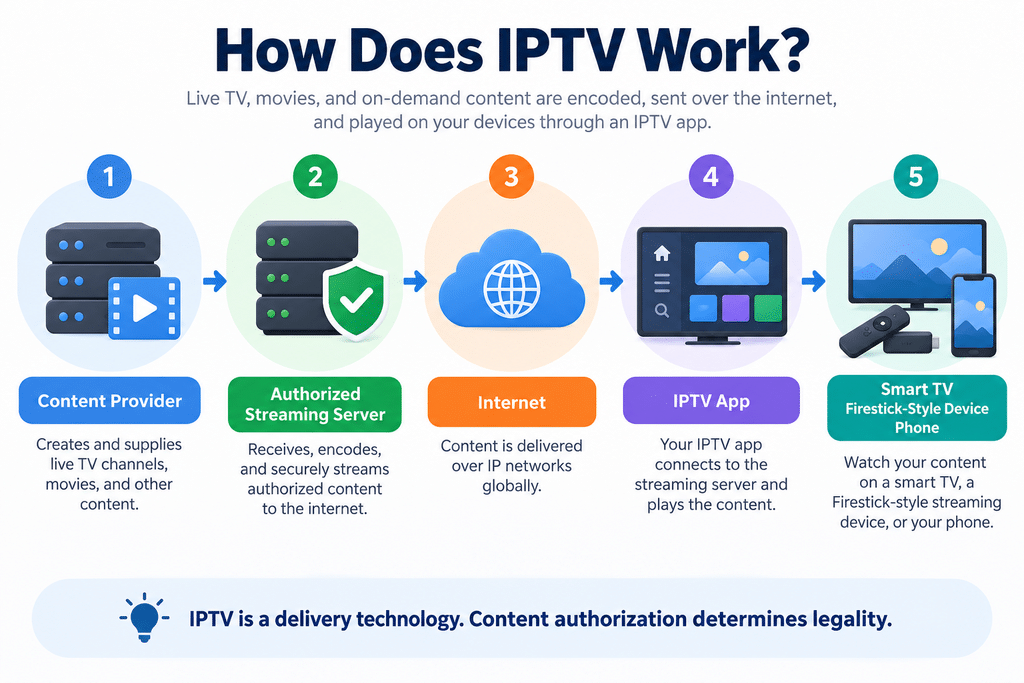
A content source supplies television or video programming. That programming is encoded into a digital format and delivered through servers and internet infrastructure. The viewer’s device receives the stream, decodes it, and displays the video.
Depending on the platform, IPTV can provide several forms of programming.
Live TV
Live television attempts to reproduce the traditional television experience. A viewer chooses a channel and watches a stream in real time.
Video on Demand
Video-on-demand libraries allow users to select a movie, episode, documentary, or other program whenever they want.
Catch-Up TV
Some systems make previously broadcast programs temporarily available after the original airing.
Time-Shifted Television
Users may be able to restart, pause, or revisit programming depending on the platform.
Electronic Program Guides
Many IPTV platforms integrate an EPG, or Electronic Program Guide, showing schedules and program information.
None of these features are inherently illegal.
The legal issue remains the same:
Does the party transmitting the programming have the necessary rights to do so?
Why Do So Many People Ask “Is IPTV Legal?”
Confusion exists because the word IPTV is used to describe very different services.
One person may use the word IPTV when talking about television delivered by a major telecommunications company.
Another person may mean a streaming app.
Someone else may mean an inexpensive subscription purchased through a small website or reseller.
Another user may be searching for an IPTV playlist.
Because all of these experiences involve internet-delivered television, they often get grouped together.
That creates misleading statements such as:
“All IPTV is illegal.”
or:
“IPTV is legal, so every IPTV subscription must be legal.”
Neither statement is accurate.
IPTV legality depends largely on content rights and authorization.
Is IPTV Legal in the USA Under Copyright Law?
To understand is IPTV legal in USA, copyright law is more important than IPTV technology.
The U.S. Copyright Act grants copyright owners a collection of exclusive rights.
Depending on the type of copyrighted work, those rights can include the ability to:
- reproduce a work,
- distribute copies,
- prepare derivative works,
- publicly perform certain works,
- publicly display certain works,
- and authorize other parties to exercise those rights.
Movies and other audiovisual works receive copyright protection.
Therefore, a company generally cannot take another company’s protected television feed, movie, or sporting broadcast and commercially retransmit it to the public merely because it has the technical ability to do so.
It needs an appropriate legal basis or authorization.
This is the central concept consumers should remember when researching legal IPTV.
The question is not:
“Does this stream work?”
It is:
“Does the party distributing this stream have the right to distribute it?”
A stream can be technically functional while still being unauthorized.
What Is the Protecting Lawful Streaming Act?
A major development in U.S. streaming enforcement came with the Protecting Lawful Streaming Act, enacted at the end of 2020.
The legislation strengthened criminal enforcement against certain commercial services whose primary purpose is illicit digital streaming.
This matters because streaming piracy had historically been treated differently in some circumstances from unauthorized downloading or distribution.
The law gave U.S. authorities a stronger mechanism for pursuing commercial operators deliberately building businesses around unauthorized streaming.
The distinction between operator and viewer is important.
The law is particularly significant for people who operate and commercially profit from illicit digital transmission services.
That is different from saying that every consumer who encounters an unauthorized stream automatically faces the same criminal penalties as the organization running the service.
Consumers should nevertheless avoid assuming that a commercial IPTV platform is legitimate merely because it accepts payments or has a professional-looking website.
What About the DMCA?
People frequently mention the Digital Millennium Copyright Act, or DMCA, when discussing IPTV.
However, the DMCA should not be treated as the entire legal explanation for IPTV.
The broader Copyright Act already establishes important exclusive rights for copyright owners.
The DMCA added important rules concerning digital copyright enforcement, technological protection measures, online service provider procedures, notices, and other internet-related copyright issues.
If copyrighted video is distributed without authorization, several parts of U.S. copyright law can potentially become relevant depending on the facts.
For consumers, the legal analysis does not need to become complicated.
The key principle remains:
A provider should have authorization for copyrighted programming it distributes.
Legal IPTV vs. Illegal IPTV
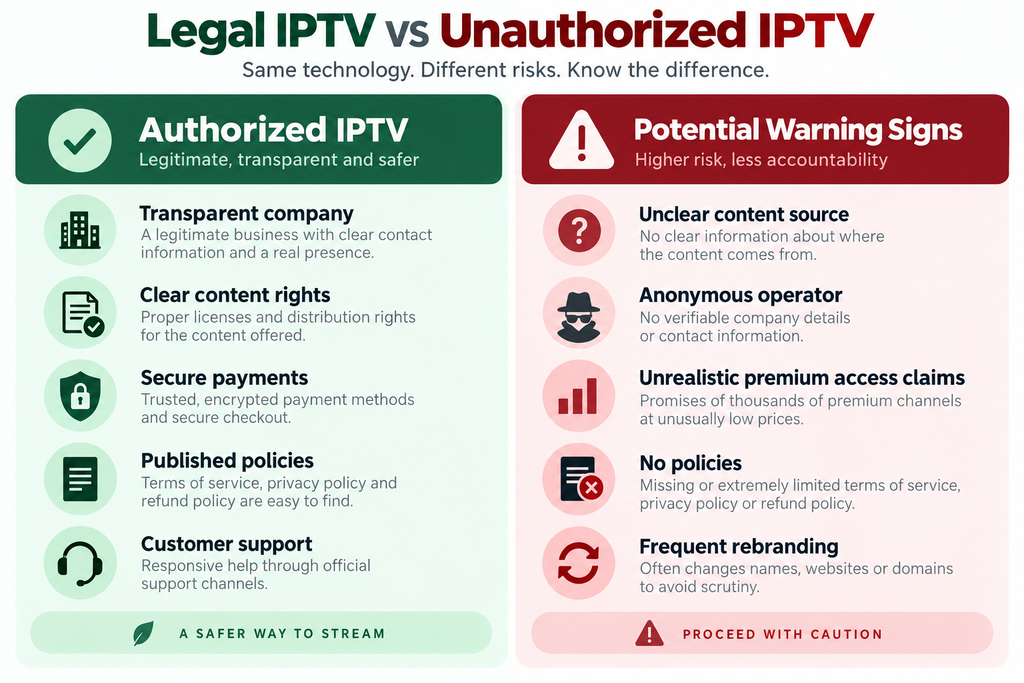
The distinction becomes clearer when we compare characteristics.
| Legal / Authorized IPTV | Potentially Unauthorized IPTV |
|---|---|
| Content is distributed with necessary rights or authorization | Premium content may be retransmitted without authorization |
| Provider identity is reasonably transparent | Ownership may be intentionally hidden |
| Terms are clear | Terms may be vague or constantly changing |
| Refund rules are accessible | Refund procedures may be difficult to find |
| Normal customer support exists | Support may disappear after payment |
| Payment processing is transparent | Payments may rely entirely on anonymous or irreversible methods |
| Service makes realistic claims | Claims may sound impossible or deliberately misleading |
| Privacy information is available | User data handling may be unclear |
| Long-term business identity is consistent | Domains and brand names may change frequently |
These points are indicators rather than automatic proof.
For example, accepting credit cards does not prove that a service has content licenses.
Likewise, a small streaming company is not automatically illegal simply because it is less famous than a national provider.
The most important factor remains authorization for the programming.
Are IPTV Subscriptions Legal?
An IPTV subscription can absolutely be legal.
There is nothing inherently unlawful about paying a monthly or yearly fee for internet-delivered television.
Consumers already pay subscriptions for numerous video and television services.
The word “subscription” tells you how access is sold.
It does not tell you whether the provider has permission to distribute the programming.
That is why consumers researching an IPTV subscription should separate two ideas:
Technology
How the video reaches the television.
Rights
Whether the provider is authorized to offer the programming.
A subscription can have impressive applications, HD streams, electronic program guides, customer service, and thousands of channels while still raising questions about authorization.
Professional presentation is not a substitute for content rights.
Is IPTV on Firestick Legal?
IPTV for Firestick is another highly searched topic.
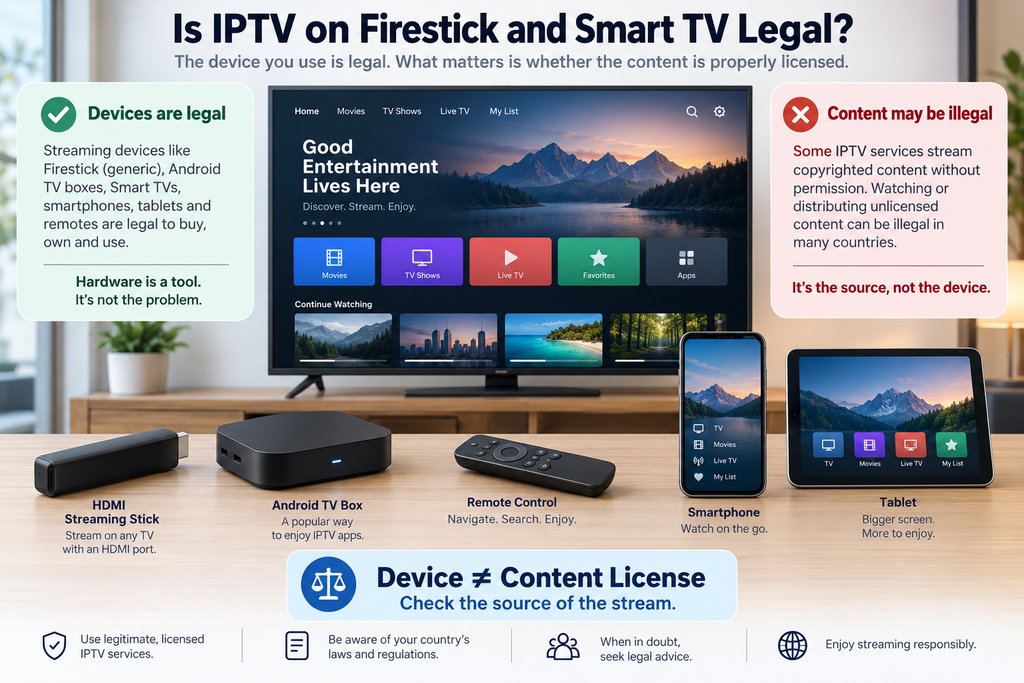
Amazon Fire TV devices are general-purpose streaming devices.
Using a Firestick is legal.
Installing a media player or IPTV player on a Firestick is also not automatically illegal.
The legal question concerns the content being accessed.
For example, using a Firestick to watch programming you are legally authorized to access is fundamentally different from knowingly purchasing unauthorized access to protected broadcasts.
The hardware itself does not determine legality.
This same principle applies to:
- Android TV boxes,
- Google TV,
- Apple TV,
- smart TVs,
- tablets,
- phones,
- computers,
- Roku-compatible streaming services,
- and other connected devices.
A device is simply the tool displaying the stream.
Are IPTV Player Apps Legal?
An IPTV player app typically acts as a media interface.
Depending on the application, the user may enter:
- account credentials,
- an M3U playlist,
- a portal address,
- or credentials supplied by a streaming provider.
Many IPTV players do not supply programming themselves.
This distinction is important.
A media player can be legal software even if someone later uses it to access unauthorized material.
The same concept exists with web browsers, media players, file managers, and other general-purpose applications.
Therefore, asking whether a particular IPTV player is legal is usually less useful than asking where the streams being loaded into the player originate.
Are M3U Playlists Legal?
An M3U file is essentially a playlist format.
The format itself is not illegal.
M3U playlists can point to authorized content, personal media, public streams, internal company streams, or unauthorized copyrighted material.
Again, legality depends on the content and authorization rather than on the file extension.
A similar principle applies to login systems often used by IPTV applications.
A username and password format is a technical mechanism.
It does not prove that the underlying content is authorized.
Can You Get in Trouble for Watching Illegal IPTV?
This is one of the most sensitive IPTV legality questions.
The biggest and clearest U.S. enforcement actions have generally focused on organizations and individuals operating or commercially profiting from illicit streaming services.
Running a large unauthorized streaming operation can create significantly more serious legal exposure than simply being a consumer.
However, viewers should not interpret that observation as legal permission to knowingly access infringing content.
Copyright law can be complicated, and individual circumstances matter.
There are also practical consequences even when a viewer never receives a legal notice.
An illegal IPTV service can:
- disappear without warning,
- lose its domains,
- lose access to servers,
- have payment accounts suspended,
- stop responding to customers,
- expose subscriber data,
- or simply take prepaid subscription money and vanish.
So the consumer risk is not limited to courtroom liability.
Is Free IPTV Legal?
The phrase free IPTV covers several completely different situations.
Legitimate Free Streaming
Some platforms legally provide free ad-supported television or public programming.
These services may be funded through advertising, public broadcasting, sponsorship, or other legitimate models.
Promotional Free Trials
A legitimate subscription service may offer temporary access so users can evaluate the platform.
Unauthorized Free Streams
Other websites or playlists may distribute copyrighted programming without permission.
The word “free” does not tell you which category you are dealing with.
A free stream can be legal.
A paid stream can be illegal.
Price alone does not decide legality.
Is Using a VPN With IPTV Legal?
VPNs have many lawful uses.
Individuals and companies use virtual private networks for:
- improving privacy,
- securing traffic on public Wi-Fi,
- accessing workplace networks,
- protecting business communications,
- and reducing exposure of certain browsing information.
Using a VPN does not automatically make IPTV illegal.
At the same time, a VPN does not convert unauthorized streaming into authorized streaming.
If a provider does not possess the necessary rights to distribute copyrighted programming, changing an IP address does not give the provider those rights.
Consumers should therefore avoid advice suggesting:
“It is legal because you are using a VPN.”
The two questions are separate.
What About IPTV and Live Sports?
Live sports are particularly important in streaming copyright enforcement because broadcasting rights can be extraordinarily valuable.
Leagues, broadcasters, and streaming platforms may spend significant amounts to obtain exclusive rights to distribute events.
Unauthorized retransmission can undermine those commercial agreements.
This is one reason illegal sports streaming receives significant enforcement attention.
In 2026, U.S. authorities demonstrated how seriously sports-streaming piracy can be treated when the Department of Justice announced actions involving more than one thousand domains allegedly used for unauthorized streaming of FIFA World Cup matches.
That enforcement activity shows why viewers should not assume that a website will remain online simply because it currently works.
A service dependent on unauthorized sports streams can lose infrastructure rapidly when rights holders and law-enforcement agencies intervene.
IPTV vs. Cable TV: Is One More Legal Than the Other?
The debate around IPTV vs cable TV often mixes technology, price, and legality.
Cable TV typically operates through established distribution agreements between networks and cable providers.
IPTV can operate under similarly legitimate agreements.
The major technological difference is how programming reaches the viewer.
Cable traditionally uses managed cable infrastructure.
IPTV uses internet protocol networks.
Therefore:
Cable is not automatically legal because it uses a cable.
and:
IPTV is not automatically illegal because it uses the internet.
What matters is whether the company has authority to distribute the programming.
How Can You Evaluate an IPTV Provider?
Consumers usually cannot inspect confidential licensing agreements.
That makes evaluation difficult.
However, several checks can help consumers make better decisions.
1. Look for a Real Business Identity
A provider should ideally make it possible to identify who operates the service.
Check for:
- company name,
- business address,
- customer support details,
- email address,
- terms and conditions,
- privacy information,
- and refund policies.
Anonymous ownership does not automatically prove infringement, but it reduces accountability.
2. Read the Refund Policy Before Paying
Do not wait until something goes wrong.
Check:
- the refund period,
- situations that qualify,
- cancellation procedures,
- how refunds are requested,
- and how long processing can take.
A vague promise such as “100% guaranteed refund” means little if the actual policy says something completely different.
3. Check the Privacy Policy
Streaming services can collect information such as:
- email addresses,
- IP addresses,
- payment-related information,
- device information,
- support messages,
- analytics data,
- and account activity.
Consumers should understand who receives this information and why.
4. Check Payment Security
Look for HTTPS encryption and reputable payment infrastructure.
Be cautious when a service requests payment through a method that provides little recourse and refuses to explain who operates the company.
Again, payment method alone is not proof of legality.
It is simply one trust signal.
5. Investigate Content Claims
This is one of the most important steps.
Ask whether the package being advertised seems commercially realistic.
If a provider claims to include nearly every premium network, every major sports package, pay-per-view events, new movies, and thousands of international channels for a tiny fraction of ordinary licensing costs, consumers should investigate further.
A large catalog does not automatically prove infringement.
But extraordinary claims deserve extraordinary scrutiny.
6. Search the Company’s History
Search for:
- how long the domain has existed,
- independent discussions,
- business registrations where relevant,
- consistent contact information,
- refund complaints,
- unexplained rebranding,
- and reports of previous shutdowns.
Do not rely exclusively on testimonials displayed on the seller’s own homepage.
7. Ask About Authorization
A consumer can ask:
“Do you have authorization to distribute the premium channels included in this package?”
A transparent answer is useful.
A provider that avoids the question entirely while advertising huge quantities of premium copyrighted programming may deserve additional scrutiny.
Red Flags That Deserve More Research
There is no single perfect test for identifying illegal IPTV.
However, the following combination of warning signs should encourage caution.
Unrealistic Pricing
A tiny monthly payment supposedly unlocking huge quantities of normally expensive premium content.
Hidden Ownership
No meaningful business identity or accountability.
Constant Domain Changes
The service repeatedly instructs customers to use new websites because old domains disappear.
Cryptocurrency Only
Cryptocurrency itself is legitimate, but a service that combines anonymous ownership, untraceable communication, no refund process, and irreversible payments creates substantially greater consumer risk.
No Policies
Missing refund, privacy, and service terms.
Suspicious Applications
Users are told to install unknown software from questionable sources.
Promises That Sound Impossible
Examples include “every channel on earth,” “100% uptime,” “zero buffering forever,” or other claims that cannot realistically be guaranteed.
No Explanation of Content Rights
The provider sells massive amounts of premium programming but refuses to discuss authorization.
No individual red flag conclusively proves illegality.
Look at the complete picture.
Security Risks of Questionable IPTV Services
Copyright is not the only reason to research a streaming provider.
Untrustworthy IPTV services can also create cybersecurity and privacy risks.
Malware
Unknown apps or installation files may contain malicious code.
This risk becomes higher when users are instructed to disable security protections or install applications from random download pages.
Credential Theft
A malicious application could potentially collect passwords or other data entered on a device.
Payment Fraud
A questionable merchant may mishandle payment information or continue charging customers after cancellation.
Personal Data Exposure
Poorly secured services may leak subscriber databases.
Phishing
Customers may receive fake renewal messages or payment links that imitate the original provider.
Device Security
Streaming boxes can contain personal accounts, email addresses, payment applications, cloud photos, and other sensitive information.
For these reasons, users should treat an IPTV application with the same security caution they would apply to any other software.
Why “It Works” Does Not Mean “It Is Legal”
One of the most common mistakes in discussions about is IPTV legal is equating technical reliability with legal authorization.
A stream may:
- load instantly,
- display in 4K,
- contain an EPG,
- work for months,
- and have responsive support.
None of those features proves that the provider owns distribution rights.
Likewise, buffering or technical problems do not prove a service is illegal.
Performance and copyright authorization are two separate issues.
Why “It’s on an App Store” Isn’t Complete Proof Either
Consumers sometimes assume:
“If I downloaded the player from an app store, everything I watch through it must be legal.”
That is not necessarily correct.
A player application may simply be a tool.
The store may approve the application itself without reviewing every third-party playlist, server, or subscription that a user later connects to it.
Therefore, distinguish between:
the IPTV application
and
the IPTV content provider.
They may be completely different businesses.
Is an IPTV Box Illegal?
No, not simply because it is an IPTV box.
Android TV boxes, Fire TV devices, Apple TV devices, smart TV systems, and set-top boxes can all be used for lawful streaming.
Problems arise when hardware is sold or configured specifically to facilitate unauthorized access to copyrighted programming.
The physical device itself remains technology.
What matters is the content and intended use.
Can IPTV Providers Be Shut Down?
Yes.
An unauthorized streaming operation may face several types of disruption.
Rights holders can pursue civil litigation.
Law-enforcement agencies can investigate criminal conduct.
Domains can potentially be seized or disabled.
Hosting companies, registrars, payment companies, or other infrastructure providers may also terminate services in response to legal action or policy violations.
For subscribers, this creates a simple financial risk:
You might purchase twelve months of access and lose the service after two months.
Even if the viewer never becomes part of a lawsuit, the subscription money can still disappear.
IPTV Enforcement in the United States in 2026
The idea that authorities ignore illegal streaming is outdated.
The U.S. Department of Justice has pursued criminal cases involving illegal digital streaming.
One notable prosecution resulted in a federal prison sentence for a Florida man who pleaded guilty to providing illegal access to digital streaming services. The DOJ described the conviction as the first believed conviction under the Protecting Lawful Streaming Act.
Enforcement became even more visible during the 2026 FIFA World Cup.
In July 2026, the Department of Justice announced that the United States had seized more than 1,000 internet domains connected to unauthorized streaming of World Cup matches through several enforcement actions.
The lesson for consumers is not that IPTV technology is being prohibited.
The lesson is that large-scale unauthorized streaming businesses can face serious enforcement.
Why Cheap IPTV Attracts Consumers
It is easy to understand why people search for inexpensive IPTV subscriptions.
Traditional television has become fragmented.
A household interested in entertainment and sports may need multiple subscriptions.
One service may carry a particular league.
Another has specific television shows.
Another owns rights to certain movies.
Regional sports may appear somewhere else.
Monthly costs accumulate quickly.
IPTV sellers often respond to that frustration by promising a single inexpensive subscription containing everything.
Consumers understandably find that attractive.
But the bigger and cheaper the package becomes, the more important it is to investigate how the service can legally provide everything it claims.
Low price is not proof of infringement.
It is simply a reason to ask more questions.
How Does a Legal IPTV Service Obtain Content?
There is no universal licensing model.
Rights may be negotiated between:
- television networks,
- studios,
- sports leagues,
- broadcasters,
- distributors,
- telecommunications companies,
- aggregators,
- and streaming services.
Agreements may be limited by:
- country,
- territory,
- language,
- device,
- platform,
- type of customer,
- and duration.
This is why one streaming service may legally offer a television program in the USA while another service carries it only in Europe.
Copyright rights can be territorial.
Therefore, a service having access to a television feed somewhere in the world does not automatically mean it may legally resell that feed to American customers.
Are International IPTV Channels Legal in the USA?
They can be.
Many immigrants and multilingual households want television from their home countries.
Authorized distributors can license international channels for U.S. audiences.
But international origin does not remove copyright protections.
The same basic test applies:
Does the distributor have authorization to retransmit the programming to its audience?
Is IPTV Better Than Traditional Streaming?
That is a separate question from IPTV legality.
IPTV can have several potential advantages:
- flexible devices,
- live television,
- integrated guides,
- on-demand programming,
- international content,
- convenient interfaces,
- and centralized access.
Traditional cable or mainstream streaming platforms may offer other benefits:
- established licensing relationships,
- predictable support,
- easier billing,
- native device applications,
- stronger parental controls,
- and more transparent content agreements.
Users should compare services according to their actual needs rather than assuming one delivery technology is automatically better.
What Should You Do Before Buying an IPTV Subscription?
Use this checklist.
Step 1: Identify the Company
Find out who operates the website.
Step 2: Read Its Terms
Understand what you are purchasing.
Step 3: Review the Refund Policy
Know what happens if the service does not work.
Step 4: Check the Privacy Policy
Understand how your information is handled.
Step 5: Review the Content Claims
Ask whether the package seems realistic.
Step 6: Research Authorization
Look for meaningful information about content rights where relevant.
Step 7: Verify Payment Security
Use a secure checkout.
Step 8: Avoid Reusing Passwords
Use unique credentials for streaming accounts.
Step 9: Download Apps From Trusted Sources
Do not blindly install unknown APK files.
Step 10: Avoid Very Long Commitments Without Research
Prepaying a year creates more financial exposure than a short subscription if you do not yet trust the provider.
Questions to Ask an IPTV Provider
Before purchasing, consider asking:
Who operates your service?
Where can I read your terms and refund policy?
How long does delivery take?
Which devices are supported?
How many simultaneous connections are included?
Does the subscription automatically renew?
How do I cancel?
How do you handle customer data?
What authorization do you have for premium copyrighted programming?
A reputable business should be able to answer basic commercial questions clearly.
What If an IPTV Service Stops Working?
First determine whether the issue is technical or whether the entire service has disappeared.
Try normal troubleshooting:
- confirm internet access,
- restart the application,
- restart the device,
- check account expiration,
- check the provider’s official status communications,
- and contact support.
Do not immediately install unknown replacement apps or send additional payments to someone contacting you privately.
If the provider’s domain, email, social accounts, and support all disappear simultaneously, the situation may be more serious.
Review your payment provider’s dispute options when appropriate.
Change any reused passwords.
Monitor accounts if you supplied sensitive information.
What If an IPTV Provider Says It Is “100% Legal”?
Do not rely on the phrase alone.
“Legal IPTV” is a marketing statement unless the underlying business practices support it.
Ask what makes the service authorized.
Look for verifiable information rather than badges created by the seller itself.
The same rule applies to claims such as:
- “fully licensed,”
- “official IPTV,”
- “authorized provider,”
- or “100% legal channels.”
A claim becomes more trustworthy when evidence supports it.
Is IPTV Legal for Businesses, Hotels, and Restaurants?
Commercial viewing introduces additional considerations.
A television subscription intended for personal residential use may not automatically include rights for public or commercial display.
Restaurants, bars, hotels, gyms, offices, and other businesses should verify that their television agreements cover the intended commercial use.
This is particularly important for major sporting events.
A subscription that allows someone to watch a game at home may not necessarily grant the same rights to show the game publicly to paying customers.
Businesses should obtain appropriate commercial licensing when required.
Is IPTV Legal in Every U.S. State?
Federal copyright law applies throughout the United States.
There may also be other federal, state, contract, fraud, computer security, or consumer protection laws relevant to particular conduct.
There is not a simple list where IPTV is “legal in one state and illegal in another.”
Again, the most important distinction concerns what the provider is actually distributing and whether it has authorization.
Does Paying for IPTV Make It Legal?
No.
Payment does not determine copyright authorization.
A customer can pay for a legitimate service.
A customer can also unknowingly pay an unauthorized reseller.
The fact that a company charges money, issues login credentials, or sends an invoice does not automatically prove it owns content rights.
Does a Website Having HTTPS Mean the IPTV Is Legal?
No.
HTTPS means the connection between your browser and the website is encrypted.
That is important for security.
It does not verify copyright licensing.
Almost any website can obtain an SSL certificate.
Treat HTTPS as a basic security requirement, not a legal certification.
Is IPTV Legal When Paid With PayPal or a Credit Card?
The payment method does not determine content legality.
A secure payment processor can reduce certain consumer risks and may provide dispute mechanisms.
However, payment processing should never be treated as proof that every channel offered by a service is authorized.
Consumers must evaluate the overall service.
Does Having a Refund Policy Prove an IPTV Service Is Legal?
No.
A refund policy is an important trust signal, but anyone can publish one.
Consumers should look at the complete business picture:
- transparency,
- authorization,
- support,
- security,
- policies,
- reputation,
- and realistic claims.
Why Google Search Results About IPTV Can Be Confusing
Search results for IPTV frequently mix several types of content:
- technology explanations,
- IPTV player tutorials,
- subscription websites,
- legal guides,
- anti-piracy articles,
- app reviews,
- Firestick tutorials,
- and advertisements.
That makes it easy for users to misunderstand what they are researching.
For example, a tutorial titled “how to set up IPTV” may simply explain a media player and say nothing about whether a particular subscription is authorized.
Likewise, an anti-piracy story may describe one illegal IPTV operation without implying that the technology itself is unlawful.
Understanding search intent helps separate these topics.
Frequently Asked Questions About IPTV Legality
Is IPTV legal in the USA?
Yes. IPTV technology is legal in the United States. Legal problems arise when copyrighted programming is distributed or publicly performed without appropriate authorization.
Is IPTV legal on Firestick?
Using IPTV technology or an IPTV player on a Firestick is not automatically illegal. The legality depends on the source and authorization of the programming being streamed.
Are IPTV subscriptions legal?
Yes, authorized IPTV subscriptions can be legal. Paying for a subscription by itself does not establish whether the provider has content rights.
Is IPTV Smarters or another IPTV player illegal?
An IPTV player is generally software that plays streams supplied from another source. The player and the content provider should be evaluated separately.
Is free IPTV illegal?
Not necessarily. There are legitimate free, ad-supported, promotional, and public streaming services. Unauthorized free retransmission of copyrighted material is a different matter.
Is IPTV legal with a VPN?
A VPN itself has lawful uses, but it does not change the copyright status of a stream. Unauthorized content does not become authorized because a VPN is active.
Can IPTV users get fined in the USA?
Legal consequences depend on the facts and applicable law. U.S. enforcement has strongly targeted commercial operators behind illicit streaming services. Consumers should not treat that as permission to knowingly access unauthorized copyrighted content.
Can an IPTV service be shut down?
Yes. Unauthorized services may face lawsuits, criminal investigations, domain seizures, hosting termination, payment disruption, or other enforcement measures.
Are IPTV boxes illegal?
The hardware itself is generally neutral. What matters is how it is configured and what content is being accessed.
Is M3U IPTV legal?
M3U is only a playlist format. An M3U playlist can contain authorized or unauthorized streams.
Is IPTV the same as piracy?
No. IPTV is a television delivery technology. Piracy involves unauthorized use or distribution of protected content.
How do I know if IPTV is legal?
Look beyond the application. Research the provider, business identity, terms, privacy and refund policies, content claims, and information about authorization.
Is IPTV legal for watching sports?
Authorized internet-delivered sports streaming is legal. Unauthorized retransmission of copyrighted sports broadcasts may infringe the rights of broadcasters, leagues, or other rights holders.
Does using IPTV violate my ISP terms?
That depends on your internet provider’s terms and what activity is occurring. Using internet video normally does not itself violate an ISP agreement, but unlawful activity can raise separate issues.
Is IPTV legal in hotels?
Hotels and businesses should verify that their subscription includes commercial or public-display rights where required. Residential streaming rights may not be sufficient.
Is IPTV legal in 2026?
The basic principle remains the same in 2026: IPTV is a legal technology, while unauthorized distribution of copyrighted programming can violate U.S. law.
Final Verdict: Is IPTV Legal in the USA?
So, is IPTV legal in the USA?
Yes.
IPTV is simply a method of delivering television through internet protocol.
The technology is used across the legitimate broadcasting and streaming industry.
But the technology does not give a provider permission to redistribute someone else’s television channels, films, television series, live sports, or other protected programming.
That requires appropriate authorization.
Consumers should therefore stop asking only:
“Is IPTV legal?”
and start asking:
“Is the specific IPTV service I am considering authorized to distribute what it sells?”
That is the question that matters.
Research the provider.
Read the terms.
Check the refund policy.
Protect your payment details.
Use trusted applications.
Investigate extraordinary content claims.
And remember that a working stream is not proof of a legal stream.
For another detailed explanation focused specifically on U.S. viewers, read the SmartVPro guide:
More IPTV technology, device, and streaming guides are available from:
Sources and Further Reading
Readers who want to research U.S. law directly should consult primary and authoritative sources, including:
- United States Copyright Office — Copyright Act and Section 106
- United States Copyright Office — Copyright basics
- United States Department of Justice — Digital streaming enforcement cases
- United States Department of Justice — Protecting Lawful Streaming Act prosecutions
- U.S. federal copyright statutes concerning illicit digital transmission services
Disclaimer: This article is for general educational and informational purposes only. It does not constitute legal advice. Copyright law can be fact-specific, and readers who require legal advice should consult a qualified attorney.