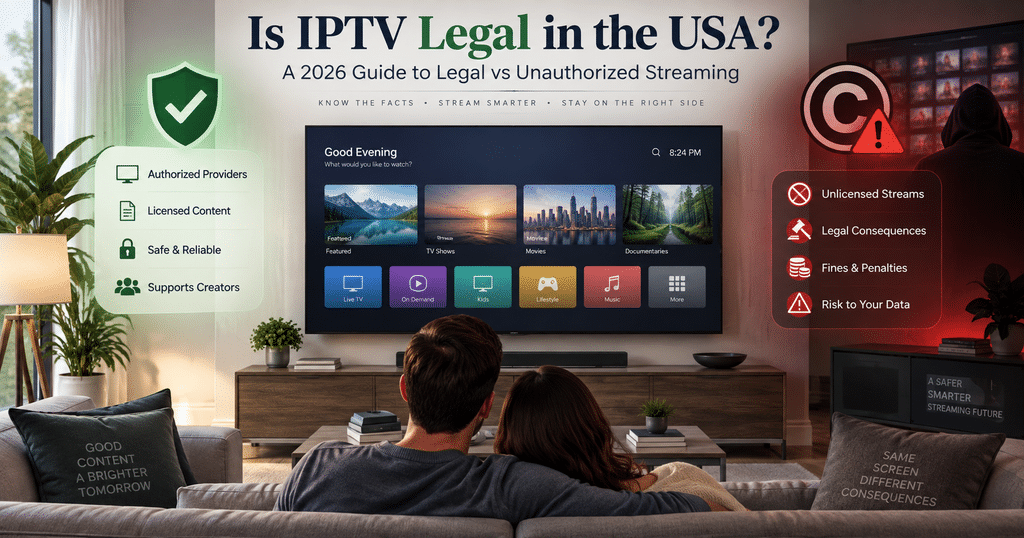
How to Tell If an IPTV Service Is Legal and Legit in the USA (2026) Choosing an IPTV provider in 2026 can feel surprisingly difficult. Search for an IPTV subscription and you will find polished websites, massive channel claims, low annual prices, free trials, apps for nearly every streaming device, and providers describing themselves as “premium,” “secure,” or “legal.” The problem is that none of those words, by themselves, prove that an IPTV service is legitimate. IPTV is simply a technology for delivering television and video over an internet connection. The technology itself has many lawful uses. The legal question normally concerns the content being distributed: does the service have authorization to provide the television channels, sports broadcasts, movies, or other programming it offers? That distinction matters. A professional-looking website does not automatically prove licensing, and an unfamiliar IPTV provider is not automatically illegal simply because you have never heard of it. The smarter approach is to evaluate the evidence. Quick answer: A legal IPTV service should have the necessary rights or authorization for the content it distributes. Consumers should look for clear business information, transparent terms, realistic claims, accessible customer support, secure payment options, clear subscription and refund rules, and credible information about content rights. No single badge, app, payment processor, DMCA page, or “100% legal” statement proves legality on its own. This guide explains how to identify a legal IPTV service in the United States, which warning signs deserve extra attention, how to evaluate payment and privacy risks, and what you should check before purchasing an IPTV subscription. This guide is for general information and consumer education. It is not legal advice. What Is a Legal IPTV Service? A legal IPTV service is a television or video service that uses internet protocol technology while distributing content under appropriate rights, permissions, licenses, or other lawful arrangements. IPTV technology is not inherently suspicious. Telecommunications companies, broadcasters, streaming platforms, hotels, universities, businesses, and other organizations can all use IP-based systems to deliver video. The issue begins when copyrighted programming is reproduced, retransmitted, or sold without authorization. This means two services can use very similar technology while having completely different legal positions. One may have contractual rights to distribute a particular group of channels. Another may simply capture or acquire copyrighted streams and resell access without permission. From a customer’s perspective, those technical systems may look almost identical inside an IPTV player. That is why judging legality based only on picture quality, channel count, an M3U URL, Xtream credentials, or the app being used is unreliable. If you want the broader legal background first, our guide on whether IPTV is legal in the USA covers the copyright framework in detail. This article focuses on the practical side: evaluating a specific provider. Legal IPTV vs. “Legit” IPTV People often use legal and legit as if they mean the same thing, but it helps to separate them. Legal mainly concerns whether the provider has the rights required to distribute the content. Legitimate is broader. A legitimate business should also behave transparently toward customers. It should explain what is being sold, charge customers as promised, provide real ways to contact support, protect payment information, disclose important subscription conditions, and follow its stated refund or cancellation rules. A provider can look professional without proving content rights. Likewise, a secure checkout protects the payment transaction, but it does not certify every television channel offered by the business. When evaluating a legal IPTV service, you therefore need to look at several signals together. The 7-Point Legal IPTV Service Check Instead of trusting one claim on a sales page, use seven areas of evidence: A strong provider should perform reasonably well across all seven. One weak signal does not automatically prove wrongdoing, but several red flags together should make you more cautious. 1. Check Who Is Actually Behind the IPTV Provider Start with the website itself. A trustworthy IPTV provider should give customers enough information to understand who they are dealing with. Look for a functioning Contact page, clear terms, a Privacy Policy, refund or cancellation information, and a consistent business identity. Pay attention to whether the company name changes between pages. For example, if the homepage uses one brand, the checkout uses an unrelated company, customer emails arrive under a third name, and the Terms of Service identify a fourth business, you should investigate before paying. Brand names and legal company names can legitimately be different. Many companies operate under trade names. The important part is whether the relationship makes sense and is explained rather than deliberately hidden. Check the Contact Information A contact form is useful, but ideally it should not be the only evidence that support exists. Look for practical support information such as an email address, customer-service page, help center, or another established way to contact the business. Try contacting the provider before purchasing a long subscription. Ask a normal question about device compatibility, billing, cancellation, or the package you are considering. You are not only testing response speed. You are checking whether the answer appears to come from someone who understands the service instead of a seller who responds with nothing except a payment link. Search the Business Name Separately Do not rely exclusively on testimonials displayed on the provider’s own website. Search the brand name together with terms such as: Look across multiple sources instead of trusting one review platform. The U.S. Federal Trade Commission recommends researching unfamiliar online sellers, reading reviews critically, checking policies, and keeping records of purchases. A legitimate online presence is not proof of content licensing, but transparent business behavior is still an important part of assessing risk. 2. Look for Evidence About Content Rights, Not Just the Word “Legal” This is the most important part of the legal IPTV question. A provider saying “we are legal” is not the same thing as demonstrating why it is authorized to distribute specific content. When possible, look for information explaining the content relationship. That could include licensing information, partnerships, distribution